You can now offer discount codes on instalment (split-payment) plans, not just one-time payments. This article explains what's new and how the discount gets calculated, so you can set up your promo codes with confidence.
Quick overview of how discounts are applied across plans
Discounts on One-Time Payments continue to work as it is, and are available on all products - Course/Package, Telegram Community, Avatar, Membership, and now onwards, to Coaching.
Discounts on Instalment plans are a new option, available only for Course/Package. Other products don't support instalment plans, so this option won't apply to them.
You can create one promo code that works on both payment types at once- just select both options when creating the code.
Setting it up
When creating a promo code for a Course/Package, you'll see:
Applicable on payment plans — choose One-time payment, Instalment plan, or both.
If you select the Instalment plan, you'll be asked to choose how the discount should be split across instalments (see below).
How the instalment discount is calculated
The discount is always calculated on the total course price, not on each instalment individually. How that total discount then gets distributed across instalments depends on which option you choose.
Lets understand via examples:
The discount is always calculated on the total course price, not on each instalment individually. How that total discount then gets distributed across instalments depends on which option you choose.
Let's understand via an example. ₹2,500 (let's consider this as the overall course price), split into 4 instalments of ₹625 / ₹625 / ₹625 / ₹625.
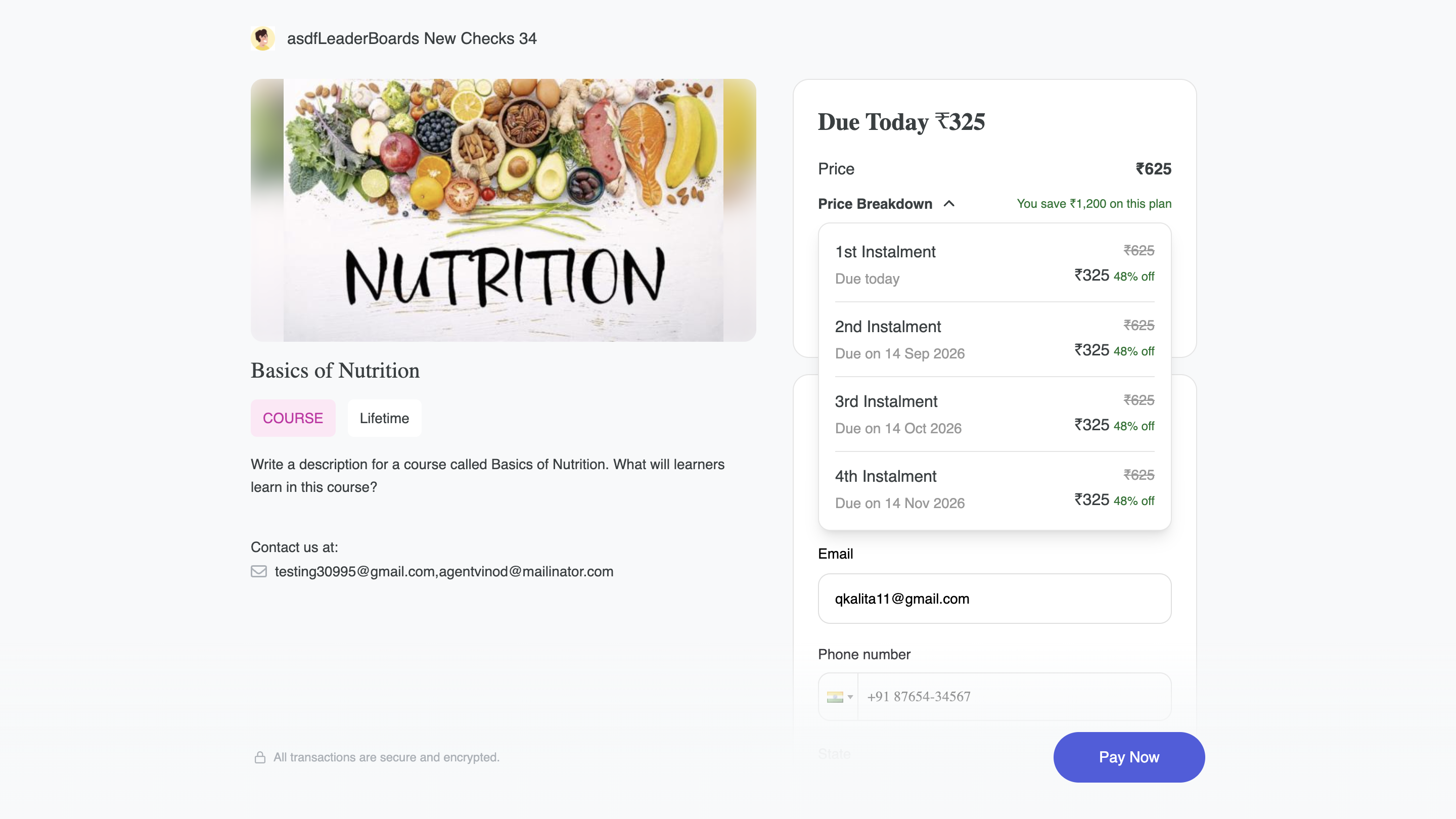
1. Distribute evenly (recommended)
The total discount is split proportionally, so every instalment gets the same percentage off.
Example: A 40% coupon reduces every instalment by 40%: ₹1,000 → ₹600, ₹2,000 → ₹1,200, ₹2,000 → ₹1,200. You pay ₹600 + ₹1,200 + ₹1,200 = ₹3,000 total, saving ₹2,000 overall.
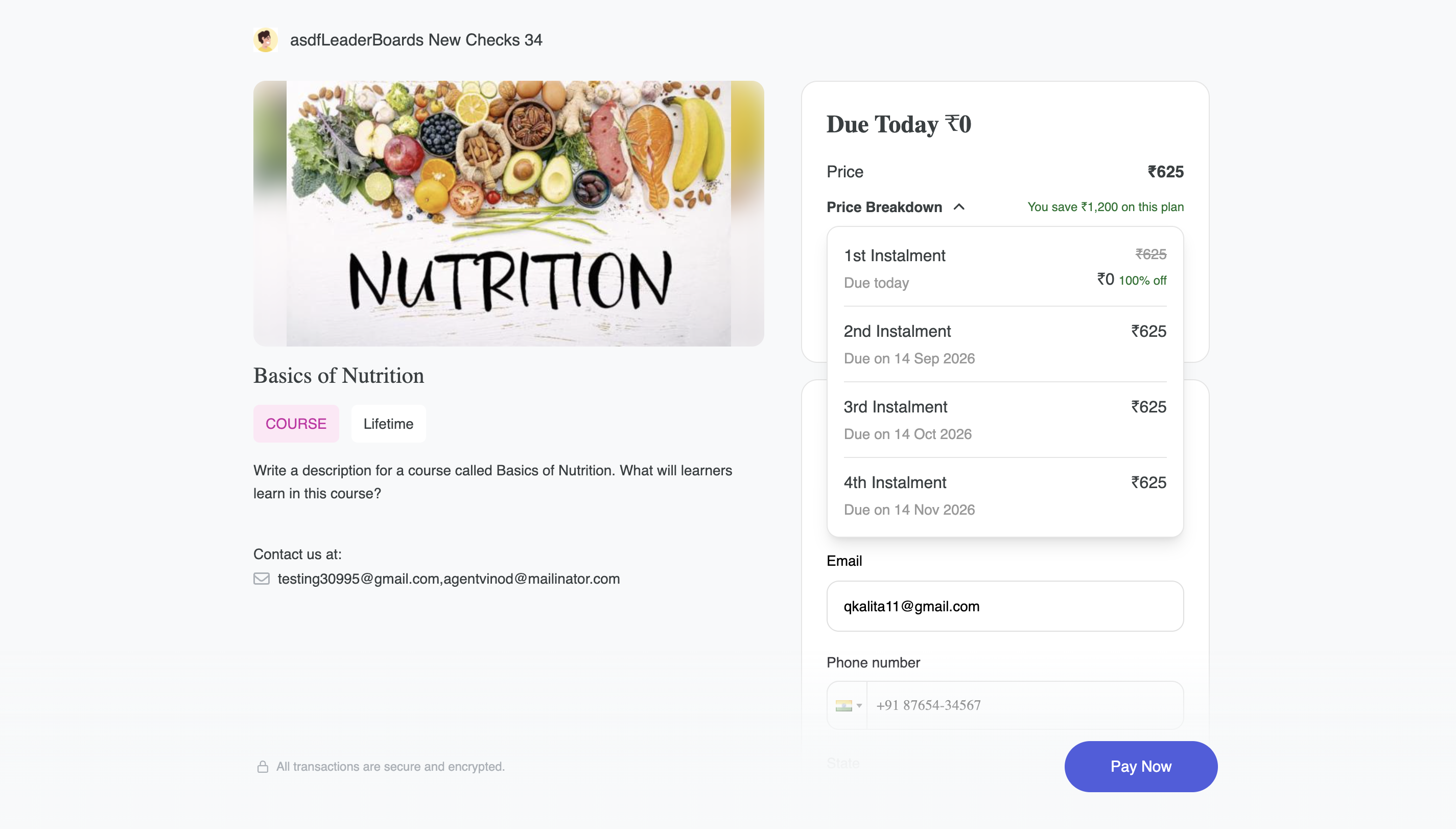
2. Apply discount only on the first instalment
The full discount is applied to instalment 1 alone. If the discount is larger than that instalment's value, it's capped there — the excess is not carried forward, and later instalments are charged in full.
Example: The ₹1,200 discount tries to apply to instalment 1 (₹625), but is capped there — instalment 1 becomes ₹0, and the remaining ₹575 of discount is lost, not carried forward. Instalments 2, 3, and 4 are charged in full at ₹625 each. You pay ₹0 + ₹625 + ₹625 + ₹625 = ₹1,875 total — only ₹625 of the ₹1,200 discount actually gets used.
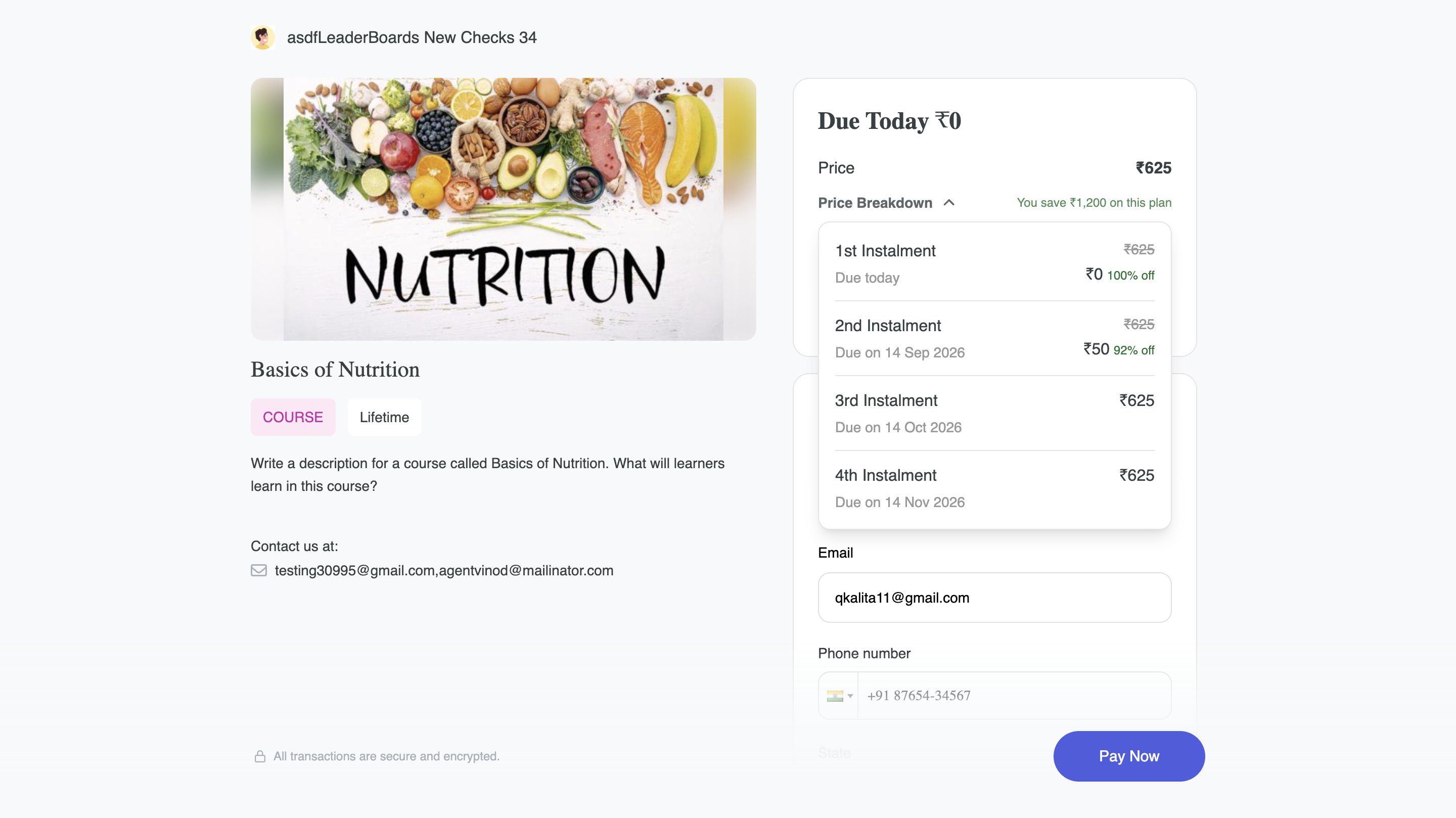
3. Highest possible discount, starting from the first instalment
The discount is applied at full strength starting with instalment 1; once an instalment is reduced to ₹0, any remaining discount rolls forward to the next instalment, and so on, until the discount is exhausted or all instalments are covered.
Example: Instalment 1 (₹625) is reduced to ₹0, using ₹625 of the ₹1,200 discount. The remaining ₹575 rolls forward into instalment 2 (₹625), reducing it to ₹50. Instalments 3 and 4 are charged in full at ₹625 each, since the discount is now fully used. You pay ₹0 + ₹50 + ₹625 + ₹625 = ₹1,300 total, using the full ₹1,200 discount.
Understand this with an example
4. Highest possible discount, starting from the final instalment
Same logic as above, but starting from the last instalment and rolling backward toward the first, until the discount is exhausted or all instalments are covered.
Example: Instalment 4 (₹625) is reduced to ₹0, using ₹625 of the ₹1,200 discount. The remaining ₹575 rolls backward into instalment 3 (₹625), reducing it to ₹50. Instalments 1 and 2 are charged in full at ₹625 each, since the discount is now fully used. You pay ₹625 + ₹625 + ₹50 + ₹0 = ₹1,300 total, using the full ₹1,200 discount.
You don't need to calculate this yourself- once you pick an option, Graphy handles the math and shows learners the discounted amount for each instalment right at checkout.
Note- In the case of scenarios Highest possible discount, starting from the first instalment and Highest possible discount, starting from the final instalment- learner won’t have a payable on the instalments that have a zero amount due (owing to discounts), and will be reminded only on the last instalment.
All other input fields on prom codes will work exactly as it did before.
Maximum Discount Value: Specify the maximum discount value that a user can avail of while applying this promo code. Example: If the course price is Rs. 1000 & you want to sell it for a minimum of Rs. 800, then you have to give the discount of a maximum of 200. Hence 200 becomes your maximum discount value.
Minimum Cart Value: Specify the minimum purchase value under which the user can avail of this. Example: If you put in Rs. 5,000 as the maximum cart value, then someone with the total purchase of Rs.5100 won't be able to avail of the discount.
Valid Till: Specify the date on which the validity period ends. Example: If you want this Promo Code to expire on 02/01/2020, then enter this very date. If someone is using the code on 03/01/2020 then he won't be able to avail of the discount.
Max Use Count: Number of times this promo code can be used. Example: If you want only the first 10 users to avail of the discount then set the number to 10.
Eligible for the learners enrolled in the course(s)- You can link the promo code with specific learner who is already enrolled into the course. Only registered participants with active course access will be eligible to use this promo code.
Link Promo Code to Affiliates- If you have an affiliate, you can link the particular promo code with the specific affiliate. These promo codes would work like affiliate codes using which learners can sign up & get discounts on courses. Please note that If you don't have an affiliate program, you can skip this option.
Eligible for learners: You can link the promo code with specific email id and that learner can use this promo code while purchasing the course through this email id.
Was this article helpful?
That’s Great!
Thank you for your feedback
Sorry! We couldn't be helpful
Thank you for your feedback
Feedback sent
We appreciate your effort and will try to fix the article